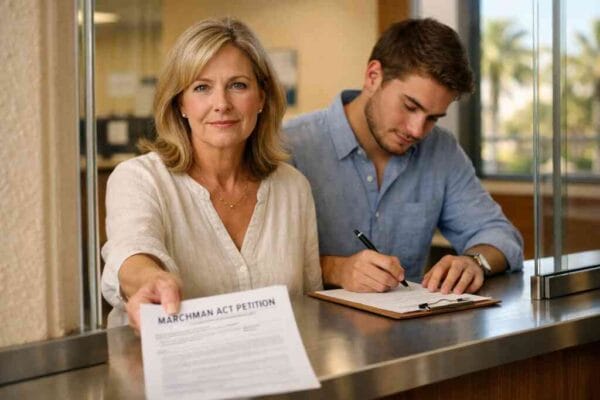
When an addiction crisis turns into a courtroom clock
The phone usually rings late. A parent sounds exhausted. A spouse sounds scared. Someone has already tried talking, begging, and setting limits, and now the question is sharper: do we need an ex parte order in Florida? If you are there right now, the pressure can feel relentless. That feeling is real, and it makes sense.
This is where the Marchman Act starts to feel less like a statute and more like a rescue tool. Under Florida law, families may seek involuntary commitment for a person with a substance use disorder when voluntary care has failed and danger is rising. The process is civil, not criminal, but it can move quickly enough to feel like a courtroom clock is ticking. Many families call it court-ordered rehab, forced rehab, or a petition for involuntary treatment, but the law uses more precise language.
One mother in Palm Beach County told us she could not sleep because her son had stopped answering texts after a fentanyl relapse. She had tried a family intervention, paid for an assessment, and even offered a ride to detox. What finally changed the conversation was not another argument; it was understanding that the court looks for evidence, not panic. That shift matters.
The moment a family starts asking whether ex parte relief is the only option
An ex parte order is not the first answer, but families often reach it after every calmer option has failed. In practice, it is a request for the judge to act before the other side is present because delay may deepen the addiction crisis. That urgency feels harsh, yet it is meant to prevent harm. If you are searching for a way to save a life from addiction, this is often the moment when legal action enters the picture.
What we see most often is a pattern, not a single incident. Alcohol, cocaine, heroin, prescription drugs, opioids, or fentanyl create repeated chaos. Bills stop getting paid. Work disappears. Children become afraid. The person may refuse a substance abuse assessment or leave stabilization before treatment can begin. At that point, a family may wonder if the Marchman Act ex parte order in Florida is the right move.
Here is the part most families miss: ex parte relief does not guarantee a bed, and it does not replace treatment planning. It is a legal door. Behind that door, the system still has to decide what level of care fits. That is why good documentation matters before filing.
What makes a substance abuse emergency different from a Baker Act situation
The Marchman Act vs Baker Act comparison matters because the two laws address different risks. The Baker Act focuses on mental health crises involving possible danger to self or others. The Marchman Act focuses on substance use disorder, impairment, and the inability to make safe decisions because of alcohol or drugs. Both are serious. Both can be misunderstood.
A person may need one law, the other, or in some cases both. Dual diagnosis cases are especially complicated because mental health and substance use disorder can overlap. A person using cocaine or prescription drugs may also have severe anxiety, depression, or psychosis. In those situations, courts and clinicians may weigh both civil commitment pathways. For a plain-English comparison, families often review the Marchman Act vs Baker Act comparison in Florida before they file anything.
The key difference is legal purpose. A Baker Act case usually centers on psychiatric danger. A Marchman Act case centers on addiction, refusal of care, and the need for stabilization. That distinction affects the petition, the hearing, and the treatment setting that follows.
Why Florida families in Miami-Dade, Broward, and Hillsborough often reach this point fast
In Miami-Dade, Broward, and Hillsborough, the pressure can build quickly because families are often balancing work, traffic, and caregiving under one roof. The opioid epidemic in Florida has also made the timeline tighter. Fentanyl moves fast. So does denial. A loved one may look “fine” one hour and disappear the next. That instability is why many families start asking about civil commitment sooner than they expected.
Local resource gaps also matter. Some counties have strong treatment networks, while others require more persistence to find the right detox or inpatient rehab placement. Families in Tampa and Orlando often ask whether county resources can bridge the gap while the court reviews a petition. They can help, but they rarely remove the need for a clear legal plan. If you are comparing local options, county resources for addiction treatment may help you see what is available nearby.
On the projects we have helped with this year, the hardest part has not been paperwork. It has been timing. The family knows something is wrong. The person using substances may not agree. That gap is where the legal process begins.
What the judge is actually looking for before an ex parte order is signed
Judges do not sign an ex parte order because a family is frustrated. They look for facts tied to Florida statute Chapter 397 and the assessment criteria for involuntary treatment. The petition must show more than conflict. It has to show a substance-related loss of control, likely harm, or a refusal of voluntary care that makes treatment necessary. This is where careful detail becomes essential.
Families sometimes expect a judge to read the room and infer the danger. That is not how it works. The court usually wants dates, behaviors, failed treatment attempts, missed work, unsafe driving, overdose concerns, or other evidence. If the petition reads like a general complaint, it may not be enough. If it reads like a clear record of decline, it has a better chance.
How Florida statute Chapter 397 frames involuntary treatment and civil commitment
Florida statute Chapter 397 is the core law behind the Marchman Act. It allows civil commitment for substance use disorder when legal criteria are met and voluntary treatment has failed or is not likely to work. The law is designed for treatment, not punishment. That distinction is important because it shapes the entire process, from petition to hearing.
The statute also ties the process to due process rights. A respondent is still entitled to notice, a hearing, and legal protections. That means the court is not simply ordering rehab because a family asks for it. Instead, the judge reviews whether the facts support involuntary treatment under Florida law. For a deeper statutory overview, families often read Florida involuntary commitment under Chapter 397.
A useful way to think about Chapter 397 is this: it gives the court a narrow tool. The tool is powerful, but it is not unlimited. It exists because addiction can destroy decision-making, yet the law still demands evidence.
What assessment criteria usually matter in a Marchman Act petition
Assessment criteria often center on ASAM criteria for level of care, even when the legal standard is not a clinical diagnosis alone. Courts and treatment providers may consider how severe the substance use is, whether withdrawal risk is present, and whether the person needs detox, inpatient rehab, or outpatient treatment. They may also consider relapse patterns, overdose risk, and whether the person can manage daily life safely.
A strong petition often includes the basics:
- the substance involved
- how often use occurs
- recent dangerous behaviors
- prior treatment attempts
- refusals of voluntary care
- signs of impairment at work, home, or driving
If a family wants help organizing that information, Florida substance abuse assessment for involuntary treatment can clarify what clinicians may look for. The assessment is not magic. Still, it gives the court and providers a structured picture.
One father in Hillsborough County brought in a notebook with missed shifts, withdrawals from the bank, and two detox refusals. Nothing about his son’s case was neat. Still, the record showed a pattern the judge could understand. That made a difference.
Why the court may want proof of risk, impairment, or refusal of voluntary care
The court wants proof because civil commitment affects liberty. That is a serious matter. So the judge usually looks for impairment, loss of control, or refusal of voluntary care. A person may say, “I am fine,” while missing work, crashing cars, or using fentanyl after an overdose scare. The law is designed for that mismatch. 
Risk does not always mean dramatic violence. It can mean dehydration, untreated withdrawal, repeated blackouts, or the inability to keep oneself safe. It can also mean refusing a detox bed after multiple attempts to help. In many cases, the refusal itself becomes part of the evidence. That is why how to file a Marchman Act petition in Florida starts with documentation, not emotion.
Here is a practical point. Judges respond better to concrete facts than labels. Say what happened. Say when. Say who saw it. Keep the focus on safety and treatment need.
Where dual diagnosis mental health concerns change the legal picture
Dual diagnosis changes the case because mental health symptoms can intensify substance use, and substance use can worsen psychiatric symptoms. If someone has bipolar disorder, trauma, major depression, or psychosis along with addiction, the court may need more than a substance-only description. The treatment plan may need both psychiatric stabilization and addiction care.
This is where a crisis stabilization unit can matter. In some cases, a person needs immediate psychiatric evaluation before rehab placement. In others, the addiction is the primary danger, and detox comes first. The right answer depends on the facts, not assumptions. That is why families sometimes involve an interventionist, an attorney, and an addiction treatment center together.
If you are trying to understand the legal side, Marchman Act Florida rights explained for families can help. If you are trying to understand the treatment side, ASAM placement criteria often guide the next step. Either way, dual diagnosis requires patience and precision.
After the order lands what the hearing means and what families can do next
Once an ex parte order is entered, the process does not end. It often accelerates. The hearing becomes the place where the court tests the petition, hears objections, and decides whether involuntary treatment should continue. Families often feel relieved and frightened at the same time. That reaction is normal.
The hearing matters because it is where rights, evidence, and treatment planning meet. It is not a criminal trial. No one is being charged with a crime simply for having a substance use disorder. Still, the respondent has legal rights, and the court must respect them. That balance is central to the Marchman Act.
How a Marchman Act hearing differs from criminal court and what rights still apply
A Marchman Act hearing is a civil process. The judge is not deciding guilt or innocence. Instead, the judge is deciding whether the facts support involuntary treatment under Florida law. That means the person subject to the petition has rights, including notice and an opportunity to be heard.
Families sometimes arrive expecting a dramatic courtroom scene. The reality is usually more restrained. There may be testimony, documents, and brief questioning. Attorneys can appear. The respondent may contest the allegations. The court may ask whether voluntary treatment was offered, whether the person understands the risk, and what level of care is appropriate. For a focused explanation, Florida Marchman Act hearing rights and judge review can be useful.
The right to a hearing is not a technicality. It is the legal safeguard that keeps the process civil. Families should prepare for that reality, not fight it.
What to expect from stabilization, detox placement, or a referral to inpatient rehab
If the court finds the criteria met, the next question is placement. Some people need stabilization first. Others need detox. Some need inpatient rehab because withdrawal risk, relapse history, or unsafe home conditions make outpatient treatment too weak. Placement should follow need, not wishful thinking.
Detox and stabilization are often the bridge between crisis and treatment. If opioids, alcohol, benzodiazepines, or fentanyl are involved, withdrawal can be dangerous. Clinicians may consider medication-assisted treatment, including buprenorphine or naltrexone when appropriate. Those medications are not right for every case, but they are FDA-approved options that may support recovery. For families trying to understand that transition, detox and stabilization after a Marchman Act petition can help frame the next step.
Sometimes the need is obvious only after the court order. One family we heard from in Orlando had spent weeks arguing about outpatient care. After the hearing, it became clear the person needed supervised detox, not another promise. The court did not create the need. It revealed it.
Where outpatient treatment, medication-assisted treatment, and county resources fit after the hearing
Not every case ends in long-term inpatient rehab. Some people transition into outpatient treatment after stabilization, especially when the clinical picture supports it. ASAM criteria help determine that level of care. That might include therapy, relapse prevention, case management, family support, and medication-assisted treatment. For opioid use disorder, buprenorphine or naltrexone may be part of a broader plan, along with counseling and monitoring.
County resources can help bridge gaps when insurance coverage is unclear. Families often ask about Medicaid, Medicare, or private pay rehab options. Coverage depends on the provider, the plan, and the service level. Some treatment centers also work with county referrals or Florida DCF resources. If you are comparing local support, Florida court-ordered rehab and recovery options can help you see what may fit after the hearing.
A simple table may help you think about the post-hearing path:
Need Possible next step Withdrawal risk Detox Medical instability Stabilization or hospital evaluation Severe relapse pattern Inpatient rehab Lower acuity, more structure needed Outpatient treatment Opioid use disorder MAT with buprenorphine or naltrexone
When to involve an attorney, interventionist, or addiction treatment center in Florida
The best time to involve help is before the paper is filed, but it is still useful after the order lands. An attorney can explain rights, deadlines, and courtroom procedure. An interventionist can help a family communicate without escalating the fight. An addiction treatment center can coordinate assessment, placement, and aftercare planning. When these pieces line up, the process becomes less chaotic.
This is also where Marchman Act hearing preparation in Florida can save time and heartache. A good team can review the petition, identify missing evidence, and discuss whether alternatives to the Marchman Act make sense. Sometimes a voluntary bed is available. Sometimes the safest choice is the court route. The point is to match the response to the crisis, not to guess.
If you are weighing Miami-Dade County Marchman Act help or support in Broward, Hillsborough, Orange, or Palm Beach, start with one clear conversation. Bring names, dates, and a record of what has already failed. You do not have to solve the entire case today. Start with a call, gather the facts, and let the legal and clinical pieces move together.
People often wait too long because they hope the next promise will hold. Sometimes it does. Often it does not. If you are ready to act, contact MarchmanAct.com for guidance, review your options, and make a plan before the situation sharpens again.
Frequently Asked Questions
Question: What is a Marchman Act ex parte order in Florida, and when does a family typically need one during an addiction crisis?
Answer: A Marchman Act ex parte order is a court order the judge may sign before the other side is present when there is evidence that waiting could put someone at greater risk. In Florida, this is part of the civil commitment process under Florida statute Chapter 397 for a person with a substance use disorder who may need involuntary treatment. Families usually start asking about it when alcohol, opioids, fentanyl, cocaine, heroin, or prescription drugs have created repeated danger and voluntary help has failed.
At MarchmanAct.com, we help families understand whether the facts support a petition for involuntary treatment, what documentation matters, and how the legal process works in real life. We focus on practical next steps such as gathering dates, behaviors, prior detox or treatment attempts, refusal of voluntary care, and other details that may help a judge review the petition. If you are looking for court-ordered rehab in Florida, forced rehab guidance, or help saving a loved one from addiction, our team can explain the process in a compassionate, careful way.
Question: How does the Marchman Act compare to the Baker Act, especially in dual diagnosis cases involving mental health and substance use disorder?
Answer: The Marchman Act and the Baker Act are both Florida laws, but they address different problems. The Marchman Act focuses on substance use disorder, impairment, and the need for involuntary treatment when a person cannot make safe decisions because of alcohol or drugs. The Baker Act is generally used for mental health crises involving possible danger to self or others. That is why the Marchman Act vs Baker Act comparison is so important for families facing a crisis.
In dual diagnosis situations, the picture can be more complex because mental health symptoms and addiction can feed into each other. A person may need a crisis stabilization unit, detox, inpatient rehab, or psychiatric evaluation depending on the facts. MarchmanAct.com helps families think through those differences without overstating what the law can do. We can help you understand assessment criteria, whether a substance abuse assessment is the right next step, and how to discuss options with an attorney, treatment provider, or interventionist. Our goal is to help families choose the most appropriate path, not simply the fastest one.
Question: What happens at a Marchman Act hearing, and what rights does the respondent still have during the legal process?
Answer: A Marchman Act hearing is a civil court hearing, not a criminal trial. The judge reviews the petition, any supporting evidence, and testimony to decide whether involuntary treatment is legally justified under Florida law. The respondent still has important rights, including notice and the opportunity to be heard, and the court must respect those rights throughout the process.
MarchmanAct.com helps families prepare for the hearing by organizing the facts in a clear, treatment-focused way. That often means documenting missed work, relapse patterns, overdose concerns, unsafe driving, refusal of detox, or repeated failed attempts at voluntary care. We also help families understand what the judge is looking for, how ASAM criteria may affect placement, and what may happen after the hearing if the court orders stabilization, detox, or inpatient rehab. If you are worried about rights in involuntary treatment or need help with Marchman Act hearing preparation, our team is here to guide you through the legal process with compassion and accuracy.
Question: After an ex parte order or petition is granted, how do detox, stabilization, inpatient rehab, and outpatient treatment fit into recovery planning?
Answer: Once an ex parte order is entered or a petition moves forward, the next step is usually placement based on clinical need. Some people need detox first, especially when alcohol, fentanyl, opioids, benzodiazepines, or other drugs create withdrawal risk. Others may need stabilization before a treatment plan is set. In some cases, inpatient rehab is the safest next step, while other situations may support outpatient treatment once the person is medically stable.
At MarchmanAct.com, we help families understand that the court order is only one part of the process. The real goal is getting the person into the right level of care using ASAM criteria and a thoughtful addiction treatment plan. That may include medication-assisted treatment such as buprenorphine or naltrexone when clinically appropriate, along with counseling and family support. We also help families think about insurance, Medicaid, Medicare, private pay, and county resources so they can better understand what may be available after the hearing. Every case is different, so we focus on realistic guidance rather than promises.
Question: How can MarchmanAct.com help families with MarchmanAct.com Explains Ex Parte Orders and Hearings 2026, and what local Florida resources do you support?
Answer: MarchmanAct.com Explains Ex Parte Orders and Hearings 2026 is designed to help Florida families make sense of a stressful and confusing process. Our team works with people dealing with an addiction crisis, including concerns involving alcohol, drugs, opioids, fentanyl, cocaine, heroin, or prescription drugs. We explain who can file a Marchman Act petition, how to file a Marchman Act petition in a general sense, what the hearing may involve, and how an attorney or interventionist can help along the way.
We support families across Florida, including Miami-Dade, Broward, Palm Beach, Orange, Hillsborough, Tampa, Orlando, and Jacksonville, and we can help point families toward county resources, Florida DCF resources, SAMHSA treatment locator information, and addiction treatment center options when appropriate. We also help people understand alternatives to the Marchman Act when voluntary treatment or another pathway may be a better fit. If you are trying to protect someone you love and need clear, compassionate guidance on involuntary commitment, civil commitment for substance use disorder, or legal steps after an ex parte order, MarchmanAct.com is a trusted place to start.